Pelvic Floor Physical Therapy After Hysterectomy: Who Needs It, What Happens and What the Evidence Shows
Pelvic floor physical therapy is treatment from a physical therapist with extra training in the muscles, nerves and connective tissue at the base of the pelvis. After a hysterectomy, it can help with leaking urine, a feeling of heaviness or bulging, pain during sex, and pelvic or tailbone pain that is not settling. This guide explains what a pelvic floor physical therapist does, who is most likely to benefit after a hysterectomy, what the research does and does not show, what happens at the appointments, and how to find a therapist and pay for it in the United States.
One point up front: not everyone needs formal therapy after a hysterectomy. Many people recover well with the simple pelvic floor exercises their hospital gives them. Therapy is most useful when you have symptoms, when you are not sure you are doing the exercises correctly, or when the problem is muscles that are too tight rather than too weak.
What the pelvic floor is and why surgery can affect it
The pelvic floor is a sling of muscles and connective tissue that stretches across the bottom of the bony pelvis, from the pubic bone at the front to the tailbone at the back. It supports the bladder, the bowel and the top of the vagina, helps keep urine and stool in until you choose to let them out, and relaxes and contracts during sex.
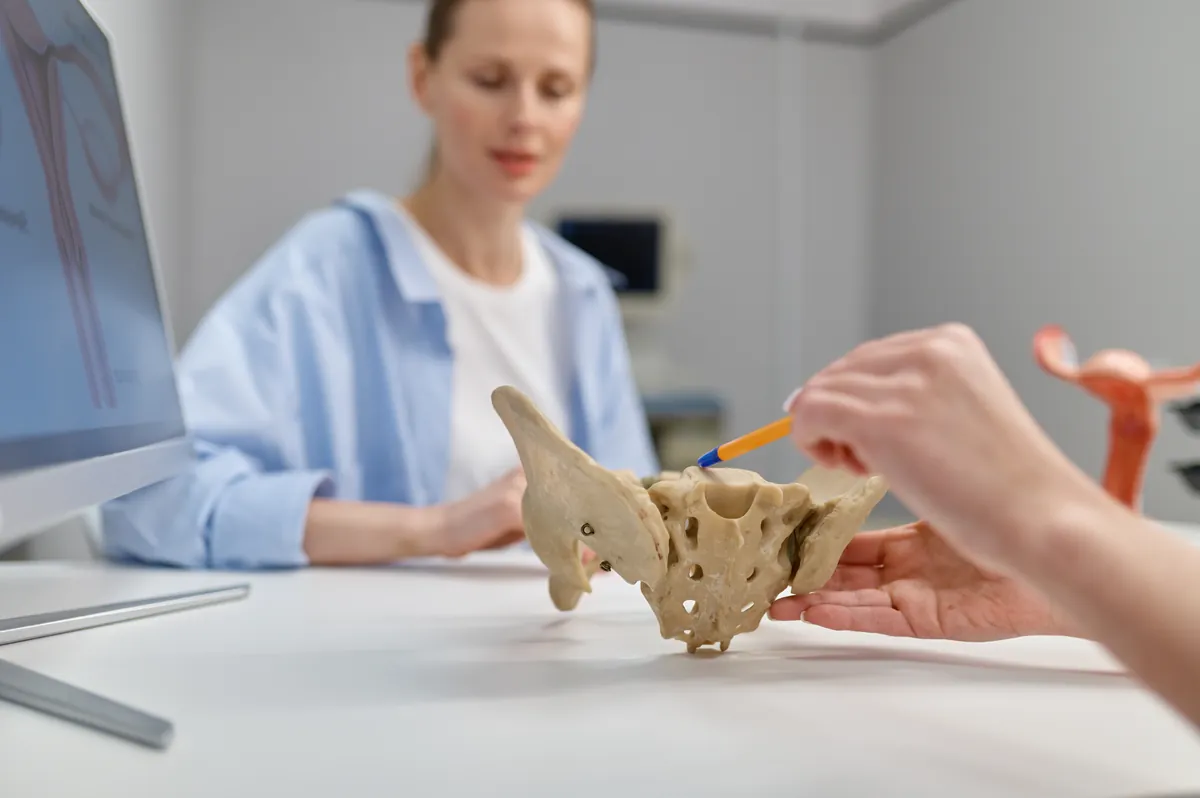
A hysterectomy changes the area these muscles support. In a total hysterectomy the top of the vagina is stitched closed, and some of the ligaments that held the uterus and cervix are cut and reattached. Other things that often come with the operation also matter: childbirth earlier in life, age, the drop in estrogen at menopause or after removal of the ovaries, constipation and straining in the first weeks, and guarding your belly because of pain.
A large Swedish registry study followed more than 165,000 women who had a hysterectomy for non-cancer reasons and compared them with about 480,000 who had not. The hysterectomy group later had surgery for stress urinary incontinence (leaking with coughing, sneezing or exercise) more often: 179 operations per 100,000 women per year, against 76 in the comparison group. A study like this shows a link, not proof that the hysterectomy itself caused the leaking, and most women in both groups never needed incontinence surgery. It does show why pelvic floor symptoms after a hysterectomy are worth taking seriously rather than putting up with.
Who is most likely to benefit
Ask your gynecologist or primary care doctor about pelvic floor physical therapy, or contact a therapist directly, if you have any of these after your hysterectomy:
- Leaking urine when you cough, sneeze, laugh, lift or exercise (stress incontinence), or a sudden urge to pass urine that is hard to hold (urge incontinence).
- A feeling of heaviness, dragging or a bulge in the vagina, especially at the end of the day. These can be signs of prolapse after a hysterectomy.
- Pain during sex or with a speculum exam once you have healed, or a vagina that feels tight or narrow.
- Trouble emptying your bladder or bowel, straining, or a feeling that you have not finished.
- Leaking gas or stool, or difficulty controlling them.
- Pelvic, tailbone, hip or low back pain that continues after the usual recovery period.
- Uncertainty about the exercises: you have tried pelvic floor exercises but cannot feel the muscles working, or you are not sure you are doing them correctly.
People who have had a radical hysterectomy for cervical cancer or radiation to the pelvis have a higher chance of bladder, bowel and sexual problems afterwards, and are a group for whom an early referral is often worth discussing with the cancer team.
What the research shows
The evidence is strong for some problems and thin for others. It helps to know which is which before you start.
Leaking urine: good evidence
A Cochrane review from 2018 pooled 31 trials with 1,817 women who had urinary incontinence. Among women with stress incontinence, those who did pelvic floor muscle training were about eight times more likely to report being cured than women who had no treatment: 56% against 6% in the trials that measured cure. These trials were not limited to women who had had a hysterectomy, but stress incontinence after a hysterectomy is the same condition. The UK’s National Institute for Health and Care Excellence (NICE) recommends a supervised pelvic floor muscle training program of at least 3 months as the first treatment for stress or mixed incontinence in women.
Prolapse symptoms: moderate evidence
In the POPPY trial, 447 women with mild to moderate prolapse were randomly assigned to one-to-one pelvic floor muscle training with a physical therapist or to a lifestyle advice leaflet. After 12 months the training group reported fewer prolapse symptoms. The difference was real but modest, and training does not reliably lift a prolapse back into place. For more on what else helps, see our guide to prolapse after hysterectomy.
Pain during sex: promising
In a Canadian trial of 212 women with a common type of vulvar pain that makes penetration painful, 10 weekly sessions of pelvic floor physical therapy (education, muscle exercises with biofeedback, hands-on therapy and dilators) reduced pain during intercourse more than a numbing lidocaine ointment. The same research group then offered 12 weekly sessions to 31 women with painful sex after treatment for gynecologic cancer. Their sexual distress, fear of pain and body image all improved. That second study had no comparison group, so it cannot show how much of the improvement was due to the therapy itself.
Routine training for everyone after a hysterectomy: unclear
A 2024 systematic review looked specifically at women after a hysterectomy. It found 6 trials with 776 participants. Pelvic floor muscle training improved sexual function compared with no training (moderate-quality evidence), but its effects on urinary symptoms, muscle strength and quality of life were too uncertain to call, and it made no difference to prolapse. Long-term effects are unknown. In the US OPTIMAL trial of 374 women having surgery for prolapse and incontinence, adding pelvic floor training with a therapist before and after the operation did not improve urinary symptoms or prolapse results compared with usual care.
Put together: if you have symptoms, supervised therapy is a sensible first step with good evidence behind it. If you have no symptoms, the hospital’s basic exercises are reasonable, but there is no strong evidence that everyone needs a course of formal therapy after a hysterectomy.
Weak or too tight? Why it matters
Pelvic floor problems are not always about weak muscles. Some people have muscles that stay tense and do not relax properly, which doctors call a hypertonic or overactive pelvic floor. It tends to cause pain during sex, pelvic or tailbone pain, difficulty starting to pass urine, straining with bowel movements and a feeling of not emptying fully. Cleveland Clinic lists injury to the pelvic muscles during surgery among its possible causes, alongside childbirth, holding in urine or stool, long periods of sitting, and stress or anxiety.
If your muscles are already tight, more squeezing is not the answer. MedlinePlus warns that doing Kegel exercises with too much force or the wrong way can lead to painful intercourse in women, and that overdoing them can cause straining when you pass urine or stool. Treatment for a tight pelvic floor focuses on learning to relax and lengthen the muscles. Telling the two problems apart is one of the main reasons to see a therapist rather than guess.
Doing the exercises correctly is also harder than it sounds. In a classic study, 47 women were given brief spoken instructions for a Kegel squeeze and then tested with pressure sensors. Only about half (49%) did an effective squeeze, and a quarter (25%) bore down in a way that could make leaking worse. The authors concluded that simple verbal or written instructions are not enough preparation on their own.
What happens at pelvic floor physical therapy
The first appointment
The first visit is usually the longest. Expect detailed questions about your surgery, childbirth history, bladder and bowel habits, sexual function, pain, medicines and what you want to get back to doing. You may be asked to keep a bladder diary for a few days, recording how much you drink, how often you pass urine and when you leak.
The therapist will then look at your posture, breathing, hips, back and belly. Many pelvic floor therapists also offer an internal examination, with one gloved finger in the vagina, to feel how well the muscles squeeze, hold and relax and whether any areas are tender. Cleveland Clinic lists internal and external pelvic muscle assessment as part of its evaluation. The internal exam is helpful but not compulsory. You can ask for it to be explained first, ask for a chaperone, stop at any time, or choose an external-only assessment.
Treatments you may be offered
- A home exercise program tailored to you: strengthening, relaxation, or both, with a set number of squeezes and holds.
- Biofeedback: small sensors, placed on the skin or inside the vagina, show your muscle activity on a screen so you can see when you are squeezing and when you are relaxing.
- Manual (hands-on) therapy to release tight or tender muscles and scar tissue, inside or outside the pelvis.
- Breathing and relaxation techniques, including diaphragmatic (belly) breathing, which helps the pelvic floor let go.
- Vaginal dilators for a vagina that feels tight or short, or after pelvic radiation.
- Bladder training to gradually lengthen the time between bathroom trips if you have urgency.
- Practical habits: “the knack” (squeezing before you cough, sneeze or lift), how to sit on the toilet to avoid straining, and how to return to lifting and exercise safely.
How long it takes
There is no fixed number of sessions. In the trials described above, women had weekly sessions for 10 to 12 weeks, and NICE recommends at least 3 months of supervised training for incontinence. Most of the work happens at home between visits. MedlinePlus says symptoms usually start to improve after 4 to 6 weeks of regular exercises, and full improvement can take several months. Benefits tend to fade if you stop completely, so a short maintenance routine is usually needed.
When to start after a hysterectomy
There are two different things to time: gentle exercises at home, and a formal assessment with a therapist.
- Gentle pelvic floor exercises: the Royal College of Obstetricians and Gynaecologists (RCOG) says you can begin them gently once your catheter has been removed and you can pass urine on your own, at least three times a day. Build up slowly towards 10 long squeezes of up to 10 seconds and 10 short, quick squeezes. Our guide on how to sit after a hysterectomy explains the basic technique step by step.
- A full assessment with a therapist: there is no single agreed timing. Many people are referred after their post-operative check, once the surgeon is happy with healing. Ask your surgeon before any internal examination, dilator or vaginal sensor in the first weeks: after a total hysterectomy the top of the vagina needs time to heal, and the NHS advises waiting at least 4 to 6 weeks, until any discharge has stopped, before sex.
- If you had problems before surgery, such as leaking or prolapse, ask whether you can see a therapist before the operation as well. You will learn the technique while you are comfortable, and the therapist will have a baseline to compare with afterwards.
For the wider picture of the first weeks, see hysterectomy recovery week by week.
How to find a pelvic floor physical therapist in the US
- Ask your gynecologist or surgeon for a referral. Hospitals with a urogynecology or gynecologic oncology service often have pelvic health therapists on staff.
- Search the directories of the American Physical Therapy Association’s Academy of Pelvic Health Physical Therapy, which lists members by location. Look for a therapist who treats pelvic floor conditions regularly; some hold a pelvic health specialist certification (WCS) or a pelvic rehabilitation certificate (CAPP-Pelvic or PRPC).
- Check whether you need a referral. According to the American Physical Therapy Association, all 50 states and the District of Columbia now allow at least some direct access to a physical therapist without a doctor’s referral, although some states still limit treatment without one. Your insurance plan may have its own referral rules.
- Telehealth can work for education, exercise coaching and follow-up visits, though an internal assessment needs an in-person appointment.
Insurance and cost
Pelvic floor therapy is billed as outpatient physical therapy. Medicare Part B covers medically necessary outpatient physical therapy: after the Part B deductible you pay 20% of the Medicare-approved amount, and there is no hard yearly cap as long as the therapy is medically necessary. Private plans vary a lot in copays, visit limits and prior authorization, so call your insurer with the clinic’s name before your first visit. Some specialist clinics do not take insurance and charge per session; ask whether they can give you a “superbill” to claim out-of-network benefits. Our guide to hysterectomy cost and insurance has more on dealing with insurers.
Questions to ask at your first visit
- Are my pelvic floor muscles weak, tight, or both?
- What exactly should I do at home, how often, and for how long?
- How will we measure whether this is working?
- How many visits do you expect, and how often?
- Which activities can I do now, and which should wait?
- What would make you send me back to my doctor?
When to see a doctor instead
Physical therapy is not the right first step for symptoms that may point to a surgical complication or another illness. Contact your surgeon, or go to the emergency room if it is severe, if you have:
- Vaginal bleeding heavier than spotting, or bleeding that starts again after it had stopped.
- Fever, chills, or smelly vaginal discharge.
- Sudden severe pain in the belly or pelvis, or a sudden gush of fluid from the vagina.
- Burning when you pass urine, blood in the urine, or being unable to pass urine.
- Leaking urine or stool continuously, without any warning, which can be a sign of an abnormal connection (fistula) that needs a doctor’s assessment.
- Pain, swelling or redness in one leg, or sudden shortness of breath.
New bleeding years after a hysterectomy, a lump you can feel, or pelvic pain that keeps getting worse also need a doctor’s assessment before or alongside therapy.
Frequently asked questions
Do I need pelvic floor therapy if I have no symptoms?
Not necessarily. The research does not show that everyone benefits from a course of formal therapy after a hysterectomy. Doing the basic exercises your hospital recommends is reasonable. One or two sessions can still be useful if you want to check your technique, return to high-impact sport or heavy lifting, or had pelvic floor problems before surgery.
Is it the same as doing Kegels on my own?
Kegels are one tool a therapist may use. Therapy adds an assessment of whether you need strengthening or relaxation, feedback on your technique, a program that progresses over time, and treatment for pain, scar tissue and bladder habits. The trials with the best results used supervised training, not a leaflet alone.
Does it help with sex after a hysterectomy?
For many people, yes. The 2024 review of trials after hysterectomy found its clearest benefit for sexual function, and therapy is a first-line option for pain during penetration. Vaginal dryness after menopause is a separate cause of painful sex that therapy alone will not fix, so ask your doctor about vaginal moisturizers or low-dose vaginal estrogen as well. See our guides on self-stimulation after hysterectomy and surgical menopause.
Is it too late if my hysterectomy was years ago?
No. There is no time limit on asking for help with leaking, prolapse symptoms or painful sex, and a therapist can assess you whenever the symptoms start. For other long-term changes, see life after hysterectomy: months and years later.
Key points
- Pelvic floor physical therapy treats leaking, prolapse symptoms, painful sex and pelvic pain with exercises, biofeedback, hands-on therapy and practical advice.
- The evidence is strongest for stress urinary incontinence; it is moderate for prolapse symptoms and promising for painful sex.
- There is no strong evidence that everyone needs formal therapy after a hysterectomy, but if you have symptoms it is a sensible first step.
- Some people need to relax the pelvic floor, not strengthen it. A therapist can tell which applies to you.
- Gentle exercises can usually begin once the catheter is out. Ask your surgeon before any internal exam or device in the first weeks.
- In the US, you can usually see a physical therapist directly, and Medicare Part B covers medically necessary outpatient therapy.
Sources
- Dumoulin C, Cacciari LP, Hay-Smith EJC. Pelvic floor muscle training versus no treatment, or inactive control treatments, for urinary incontinence in women. Cochrane Database of Systematic Reviews. 2018;10:CD005654. pubmed.ncbi.nlm.nih.gov
- Altman D, Granath F, Cnattingius S, Falconer C. Hysterectomy and risk of stress-urinary-incontinence surgery: nationwide cohort study. The Lancet. 2007;370:1494–1499. pubmed.ncbi.nlm.nih.gov
- de Oliveira NFF, Santuzzi CH, da Conceição TV, et al. Pelvic floor muscle training for urinary symptoms, vaginal prolapse, sexual function, pelvic floor muscle strength, and quality of life after hysterectomy: a systematic review with meta-analyses. Brazilian Journal of Physical Therapy. 2024;28:101122. pmc.ncbi.nlm.nih.gov
- Hagen S, Stark D, Glazener C, et al. Individualised pelvic floor muscle training in women with pelvic organ prolapse (POPPY): a multicentre randomised controlled trial. The Lancet. 2014;383:796–806. pubmed.ncbi.nlm.nih.gov
- Barber MD, Brubaker L, Burgio KL, et al. Comparison of 2 transvaginal surgical approaches and perioperative behavioral therapy for apical vaginal prolapse: the OPTIMAL randomized trial. JAMA. 2014;311(10):1023–1034. pmc.ncbi.nlm.nih.gov
- Morin M, Dumoulin C, Bergeron S, et al. Multimodal physical therapy versus topical lidocaine for provoked vestibulodynia: a multicenter, randomized trial. American Journal of Obstetrics and Gynecology. 2021;224:189.e1–189.e12. pubmed.ncbi.nlm.nih.gov
- Cyr MP, Dumoulin C, Bessette P, et al. A prospective single-arm study evaluating the effects of a multimodal physical therapy intervention on psychosexual outcomes in women with dyspareunia after gynecologic cancer. Journal of Sexual Medicine. 2021;18:946–954. pubmed.ncbi.nlm.nih.gov
- Bump RC, Hurt WG, Fantl JA, Wyman JF. Assessment of Kegel pelvic muscle exercise performance after brief verbal instruction. American Journal of Obstetrics and Gynecology. 1991;165:322–327. pubmed.ncbi.nlm.nih.gov
- NICE. Urinary incontinence in women. Quality standard QS77, statement 4: supervised pelvic floor muscle training. nice.org.uk
- Royal College of Obstetricians and Gynaecologists. Abdominal hysterectomy: recovering well (patient information). rcog.org.uk
- MedlinePlus. Kegel exercises – self-care. US National Library of Medicine. medlineplus.gov
- Cleveland Clinic. Hypertonic pelvic floor: symptoms, causes and treatment. my.clevelandclinic.org
- Cleveland Clinic. Pelvic health rehabilitation. my.clevelandclinic.org
- NHS. Hysterectomy: recovery. nhs.uk
- American Physical Therapy Association. Direct access advocacy. apta.org
- Medicare.gov. Physical therapy coverage. medicare.gov
This article is for general information and is not a substitute for medical advice. Talk to your gynecologist or surgeon before starting pelvic floor therapy after a hysterectomy, and contact them or emergency services if you have bleeding, fever, severe pain or any symptom that worries you.