Vaginal Cuff Healing After a Total Hysterectomy: Timeline, What Is Normal and Warning Signs
After a total hysterectomy, the surgeon closes the top of the vagina with stitches. That stitched line is called the vaginal cuff, and it is the one part of the operation you cannot see healing. This guide explains where the cuff is, what normal healing looks and feels like week by week, why you are asked to keep things out of the vagina for a while, which problems can happen and how often, and which symptoms mean you should call your surgeon or go to the emergency room.
Advice on timing varies between hospitals and surgeons, and much of it is based on expert opinion rather than trials. Where your own surgeon’s instructions differ from what you read here, follow your surgeon.
What the vaginal cuff is
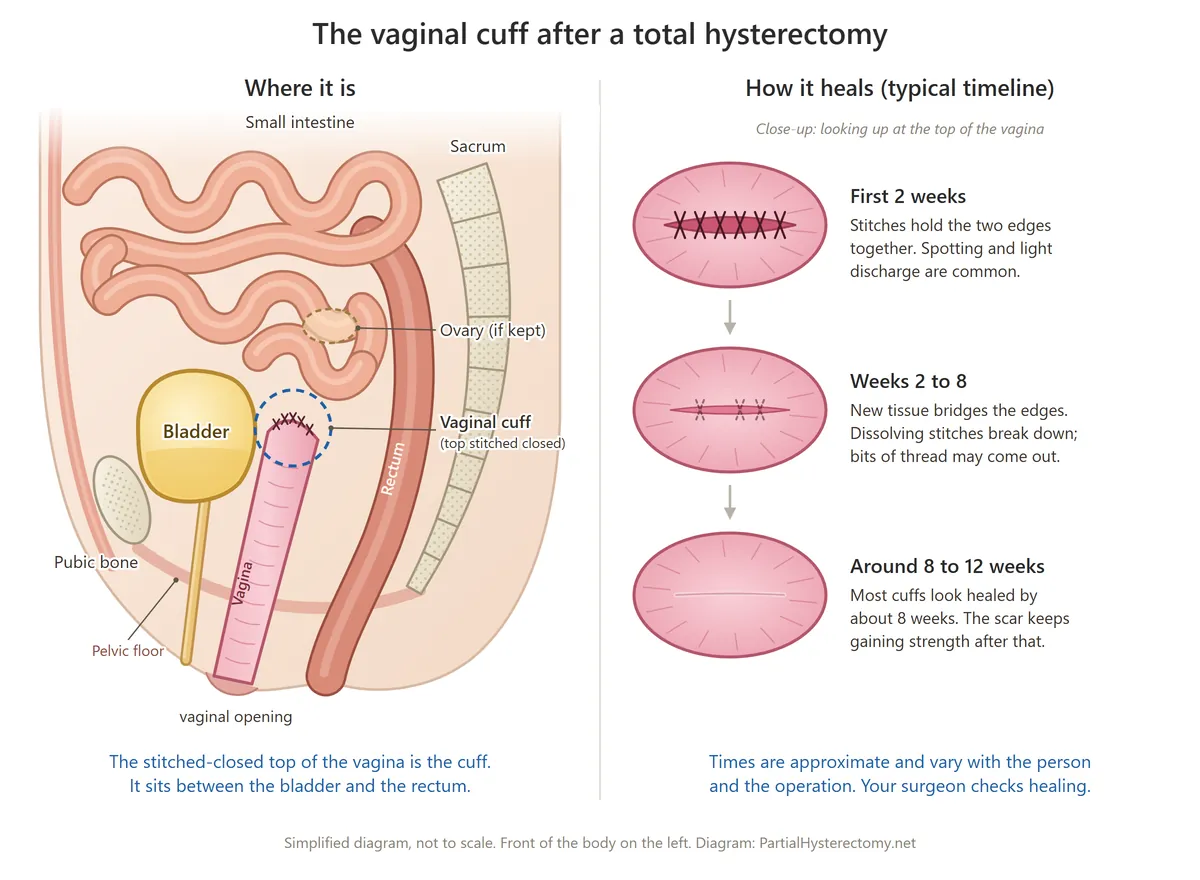
In a total hysterectomy, the uterus and the cervix are both removed. The cervix sits at the top of the vagina, so taking it out leaves an opening there. The surgeon closes that opening with dissolving stitches, and the vagina becomes a closed tube with a seam at the top. That seam is the vaginal cuff (doctors also call it the vaginal vault once it has healed).
Who has a vaginal cuff
- Total or radical hysterectomy: yes, whatever the route: abdominal, vaginal, laparoscopic or robotic.
- Supracervical (partial) hysterectomy: no. The cervix stays in place, so the top of the vagina is not opened. See partial vs total hysterectomy for the difference.
Whether your ovaries were kept or removed does not change the cuff itself. After it heals, the closed top of the vagina is also why sperm cannot go anywhere after a total hysterectomy (see where does sperm go after a hysterectomy).
How the cuff heals: a typical timeline
There is no single official timeline, but patient guides and studies give a fairly consistent picture. Use it as a rough guide, not a countdown.
The first two weeks
The stitches are doing the work of holding the two edges together. Light vaginal spotting is common: MedlinePlus describes it as lasting about two to four weeks after a vaginal hysterectomy and looking pink, red or brownish, without a bad smell.[2] The NHS says bleeding or discharge can continue, more lightly than a period, for up to six weeks.[1]
Weeks two to eight
New tissue grows across the seam, and the dissolving stitches slowly break down. MedlinePlus says the stitches inside the vagina dissolve over 8 to 12 weeks,[3] so it is normal to notice a small piece of thread on a pad or on toilet paper during this time. Discharge usually becomes lighter and changes from red to brown to yellowish or clear.
One study checked the cuff of 235 women after an abdominal hysterectomy for non-cancerous conditions: it was completely healed in 80% at six weeks and in 96% at eight weeks. Using electrosurgery to open the vagina and closing it with a single running stitch were linked to slower healing. The authors suggested eight weeks as a better time for the first cuff check.[4]
After about eight weeks
By now most cuffs look healed: a thin, pale line at the top of the vagina. Looking healed is not the same as being as strong as it will become, though. Cuff separation, the rare but serious complication described below, has been reported from a few days to many months after surgery, with most cases in the first 6 to 12 weeks.[9] That is why some surgeons ask for a longer wait before sex, especially after a laparoscopic or robotic hysterectomy.
What is normal while the cuff heals
- Light spotting or bleeding, lighter than a period, that fades over the weeks.[1][2]
- Pink, brown, yellowish or clear discharge without a bad smell.[2]
- Small pieces of stitch material coming out.[3]
- A mild pulling or aching feeling deep in the pelvis that slowly improves, especially after you have been on your feet for a long time.
What is not expected: bleeding that soaks pads or gets heavier, clots, a strong or foul smell, a sudden gush of watery fluid, fever, or pain that gets worse instead of better. Those are covered in when to call below. Itching with a thick white discharge is more likely to be thrush than a cuff problem; see yeast infection after hysterectomy.
Protecting the cuff: what to avoid and for how long
Most of these rules exist to avoid pressure or stretching on the seam while it is still weak, and to avoid bringing in infection. The exact times differ between sources, which tells you something: nobody has run a trial to find the right number. A 2025 review of cuff separation after laparoscopic and robotic hysterectomy concluded that current advice on avoiding sex is based on expert opinion and that the best waiting time is unknown.[9]
Nothing in the vagina
MedlinePlus advises putting nothing into the vagina, including tampons and douches, for the first 8 to 12 weeks.[2][3] Use pads for any bleeding or discharge. Douching is not needed at any stage; the vagina cleans itself.
Sex
- NHS: wait until your scars have healed and any discharge has stopped, usually at least four to six weeks.[1]
- MedlinePlus, vaginal hysterectomy: at least eight weeks, and only with your surgeon’s approval; possibly 12 weeks if you also had vaginal repairs.[2]
- MedlinePlus, laparoscopic hysterectomy: at least 12 weeks, and only after your surgeon says it is OK.[3]
Intercourse is the main avoidable trigger that has been linked to cuff separation, particularly in younger women.[6][8] So the cautious approach is to wait for your surgeon’s go-ahead, then start gently, with plenty of lubricant, and stop if it hurts. Sex that does not involve vaginal penetration is a different matter and is not what these rules are about. For the emotional and physical side of sex after surgery, see rediscovering pleasure after hysterectomy.
Baths, pools and hot tubs
Showers are fine. MedlinePlus says not to swim or soak in a bathtub or hot tub until your surgeon tells you it is OK;[3] the NHS says you can swim once your wounds have healed.[1]
Straining, lifting and coughing
Sudden pressure inside the abdomen pushes down on the cuff. In published cases of cuff separation, straining on the toilet, coughing or sneezing was the trigger in roughly 16% to 30%.[6] In practice:
- Avoid constipation. Drink enough, eat fiber, and use the stool softener or laxative your hospital suggests rather than pushing hard.
- Lift light things only at first. MedlinePlus suggests no more than about 10 pounds (a gallon of milk) in the early weeks after a laparoscopic hysterectomy.[3] Build up gradually; there is no evidence for a lifelong lifting limit.
- Support yourself when you cough or sneeze, for example by holding a pillow against your belly. Tell your doctor if you have a cough that will not go away.
Our guide to sitting and pelvic floor exercises after hysterectomy and the week-by-week recovery guide cover everyday movement in more detail.
Smoking
Smoking is the risk factor for cuff separation reported most often, though not every study finds a link. In one large Italian series it roughly doubled to tripled the risk (odds ratio 2.65).[9] If you smoke, stopping, even for the weeks around surgery, helps the cuff heal.
The post-op check
Many surgeons look at the cuff at a follow-up visit around six weeks. A normal check is reassuring, but it is not a guarantee. In a Mayo Clinic review of 2,051 women presented at a 2020 gynecologic surgery meeting, all 13 women who later had a cuff separation had an intact cuff at their six-week exam, and most women without symptoms had normal findings.[10] The practical message: what you notice after that visit matters as much as the visit itself. Sudden pain, bleeding or a gush of fluid weeks later still needs a call.
Possible cuff problems
Granulation tissue (common, usually minor)
Granulation tissue is extra healing tissue that forms small, red, moist bumps along the seam. It is not dangerous, but it can cause spotting, a persistent discharge or light bleeding after sex. It is common: in a study of 352 women after an abdominal hysterectomy it was found in 34%. About half of the patches went away on their own, more often when they were small (72% of those 5 mm or less).[5] When it does not settle or causes symptoms, it is usually treated in the office, most often by touching it with silver nitrate. How the cuff is opened and stitched also seems to affect how quickly it heals.[4]
Infection or a collection of blood at the cuff
The tissue around the cuff can become infected (cuff cellulitis), and occasionally blood or pus collects just above it (a hematoma or abscess). Typical signs are fever, pelvic pain that gets worse instead of better, and a foul-smelling discharge, often in the first days or weeks after surgery. MedlinePlus lists fever above 100.5°F (38°C) and foul-smelling discharge among the reasons to call your surgeon.[3] These problems are treated, usually with antibiotics and sometimes by draining the collection, and an infection or collection at the cuff is one of the factors thought to weaken healing.[6] So do not wait it out.
Cuff separation (dehiscence) and evisceration (rare, urgent)
Very rarely, the seam opens partly or completely. This is called vaginal cuff dehiscence. If the opening is large, loops of bowel can slip down into the vagina (evisceration), which is a surgical emergency.
- How often: in a US hospital series, the 10-year rate across all types of hysterectomy was 0.24%, and 1.35% after total laparoscopic hysterectomy.[7] A 2025 meta-analysis of laparoscopic and robotic hysterectomy for non-cancerous conditions (26 studies, about 10,000 women) found an overall rate of 0.7%.[9] In an Italian multicenter study of 8,635 hysterectomies, evisceration happened in 0.39%.[8]
- When: usually in the first weeks to months, with most cases in the first 6 to 12 weeks, but it has been reported much later.[6][9]
- Triggers: intercourse in about 8% to 48% of reported cases, straining or coughing in 16% to 30%, and no clear trigger in up to 70%.[6] In the Italian study, intercourse was the main trigger in younger women and spontaneous separation was more common in older women.[8]
- Symptoms: pelvic or abdominal pain, vaginal bleeding or a watery discharge, and a feeling of pressure or of something bulging in or out of the vagina.[6]
- Treatment: usually repair in the operating room, through the vagina, laparoscopically or through the abdomen, depending on the situation.[6][9]
Several things have been suggested to raise the risk: smoking, diabetes, long-term steroids, previous pelvic radiation, a thin vaginal lining after menopause, a cuff infection or hematoma, and conditions that cause a chronic cough or straining. For most of them the evidence is weak.[6] Some studies also point to the surgical technique, such as the type of stitch and the use of heat energy to open the vagina; that part is up to your surgeon.[6][9]
The cuff in the long term
Once healed, the cuff is simply the top of your vagina. A few things are worth knowing for the years ahead:
- Prolapse: the top of the vagina can drop later in life (vaginal vault prolapse). See why prolapse occurs after a hysterectomy.
- Screening: most women who had a total hysterectomy for non-cancerous reasons no longer need Pap tests, but some do. See Pap smear after hysterectomy.
- New bleeding years later: bleeding from the vagina long after the cuff has healed is not normal and should be checked by your doctor.
When to call your surgeon, and when to go to the ER
Call your surgeon the same day if you have:[1][2][3]
- a fever above 100.5°F (38°C);
- vaginal bleeding heavier than light spotting, or passing clots;
- a foul-smelling discharge;
- a heavy, watery vaginal discharge;
- pelvic pain that is getting worse instead of better, or that your pain medicine does not control;
- pain or burning when you pass urine, or being unable to pass urine.
Call 911 or go to the emergency room if you have sudden, severe pelvic or abdominal pain, a sudden gush of fluid or blood from the vagina, or you feel or see something bulging at or out of the vaginal opening. Lie down while you wait for help and do not try to push anything back in. Chest pain, sudden shortness of breath, or a swollen, painful leg are also emergencies after surgery.
Sources
- NHS. Hysterectomy: recovery. nhs.uk
- MedlinePlus. Hysterectomy – vaginal – discharge. US National Library of Medicine. medlineplus.gov
- MedlinePlus. Hysterectomy – laparoscopic – discharge. US National Library of Medicine. medlineplus.gov
- Watcharaprapapong J, Treetampinich C, Na Ayudhya NI, et al. Incidence of complete vaginal cuff wound healing at sixth and eighth week after total abdominal hysterectomy. Journal of Obstetrics and Gynaecology Research. 2019. pubmed.ncbi.nlm.nih.gov
- Saropala N, Ingsirorat C. Conservative treatment of vaginal vault granulation tissue following total abdominal hysterectomy. International Journal of Gynecology & Obstetrics. 1998. pubmed.ncbi.nlm.nih.gov
- Cronin B, Sung VW, Matteson KA. Vaginal cuff dehiscence: risk factors and management. American Journal of Obstetrics and Gynecology. 2012;206(4):284–288. pmc.ncbi.nlm.nih.gov
- Hur HC, Donnellan N, Mansuria S, et al. Vaginal cuff dehiscence after different modes of hysterectomy. Obstetrics & Gynecology. 2011. pubmed.ncbi.nlm.nih.gov
- Ceccaroni M, Berretta R, Malzoni M, et al. Vaginal cuff dehiscence after hysterectomy: a multicenter retrospective study. European Journal of Obstetrics & Gynecology and Reproductive Biology. 2011. pubmed.ncbi.nlm.nih.gov
- Zorzato PC, Vizza R, Garzon S, et al. Incidence and prevention of vaginal cuff dehiscence after laparoscopic and robotic hysterectomy in benign conditions: an updated systematic review and meta-analysis. Medicina (Kaunas). 2025;61(4):647. pmc.ncbi.nlm.nih.gov
- MDedge ObGyn. Is a pelvic examination necessary 6 weeks after hysterectomy? Conference coverage of a Mayo Clinic study by Delara and colleagues (2020). mdedge.com
This article is for general information and is not a substitute for medical advice. Follow the recovery instructions your own surgeon gives you, and contact your surgical team or emergency services if you have bleeding, fever, worsening pain or any symptom that worries you after a hysterectomy.