Endometrial Ablation vs Hysterectomy for Heavy Periods: Results, Risks and How to Choose
If heavy periods are running your life and medicines have not helped, two surgical answers usually come up: endometrial ablation, a short procedure that destroys the lining of the uterus, and hysterectomy, which removes the uterus. Both have been compared in randomized trials. Ablation is quicker and easier to recover from; hysterectomy is more certain to end the bleeding. This guide explains how each works, what the studies found, the risks, and the questions that usually decide between them.
The short answer
- Ablation is done through the vagina and cervix, with no cuts on the abdomen. Most women go home the same day and are back to normal activities within days. Periods usually become much lighter, but they do not always stop.[1][9]
- Hysterectomy ends periods for good, and more women report that their bleeding improved and that they are satisfied. It is major surgery with a longer recovery.[1][2]
- Ablation does not always last. About 1 in 8 women have a hysterectomy within five years of ablation, and the risk is higher the younger you are.[3][4][5]
- Neither is for women who may want a pregnancy. After ablation, pregnancy is unlikely but possible and risky, so contraception is still needed until menopause.[6][9]
How endometrial ablation works
The endometrium is the lining of the uterus that builds up and sheds each month as a period. Ablation destroys most of that lining so there is far less tissue left to bleed. A thin instrument is passed through the cervix into the uterus; nothing is cut on the outside. Depending on the device and the hospital, it is done with local anesthetic, sedation or a general anesthetic.[9]
Before ablation, your doctor should take a sample of the lining (an endometrial biopsy) to rule out precancerous changes or cancer, because ablation is not a treatment for either.[6] An ultrasound is often done to check the size and shape of the uterus and look for fibroids or polyps.
Older and newer methods
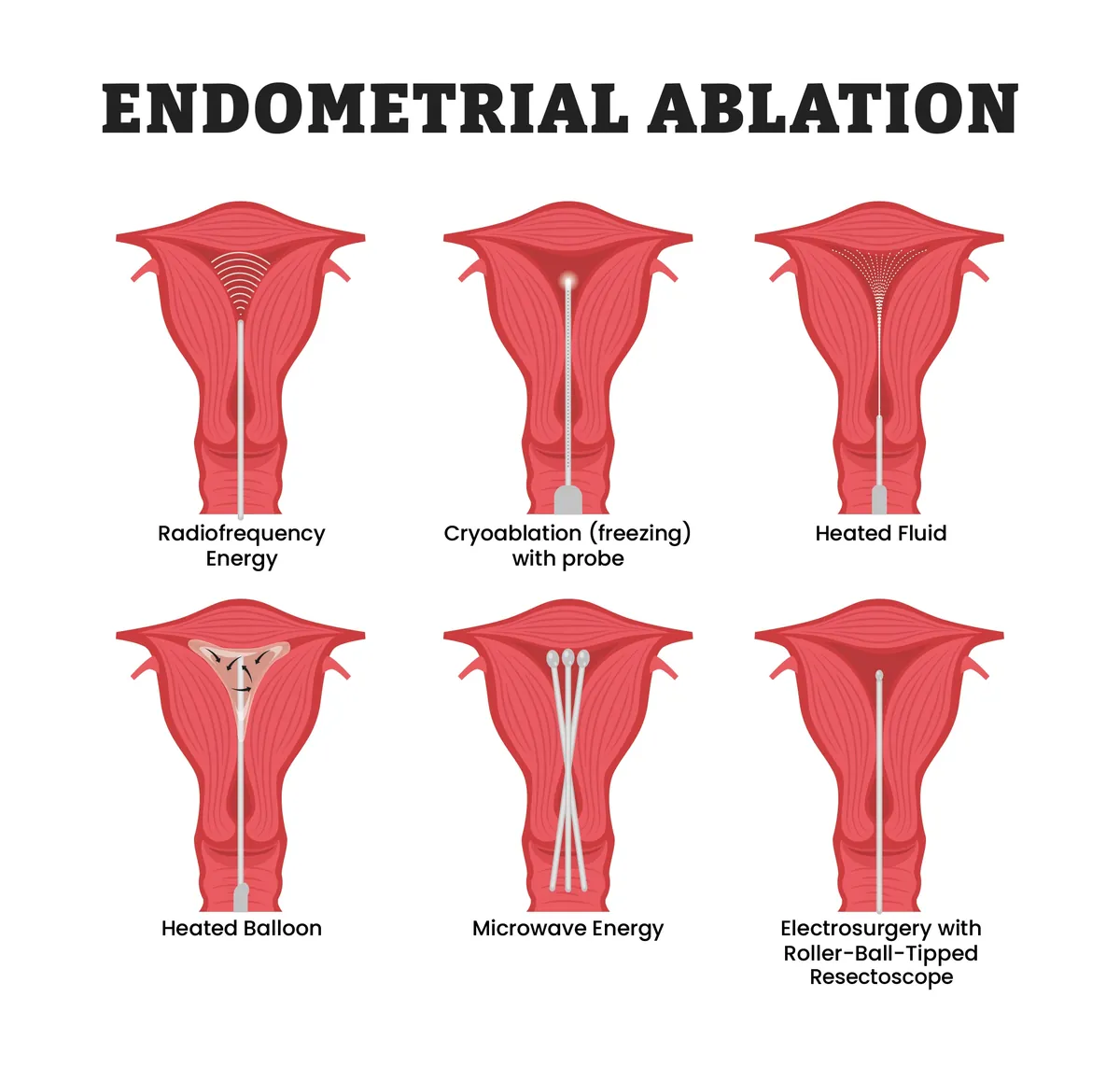
First-generation (resectoscopic) ablation was the original technique. The surgeon looks at the lining through a resectoscope and destroys it with a rollerball electrode, or removes it with an electrical wire loop (endometrial resection). It takes more skill and usually a general anesthetic, but it lets the surgeon see what is being treated and remove small fibroids or polyps at the same time.
Second-generation ablation uses devices that treat the whole cavity at once without the surgeon steering an instrument over every part of it: a heated balloon, radiofrequency energy through a mesh, circulating heated fluid, microwave energy or freezing (cryoablation). These are quicker and are often done as an office or day procedure. UK guidance from NICE favors the second-generation devices when the uterus has no structural problem.[8] Studies have not found clear differences in long-term hysterectomy rates between the different second-generation devices.[3][4]
What recovery from ablation is like
Cramping, like period pain, is common for a day or two, and a watery or bloody discharge can last a few weeks.[9] Most women are back at work and normal activities within a few days. In a Cochrane review of trials, women returned to normal activity about three weeks sooner after ablation than after an open (abdominal) hysterectomy.[1]
How hysterectomy treats heavy bleeding
A hysterectomy removes the uterus, so there is no lining left to bleed and periods stop permanently. It can be done through the vagina, by keyhole (laparoscopic or robotic) surgery, or through a cut on the abdomen. When the cervix is left in place it is called a partial (supracervical) hysterectomy. The ovaries do not have to be removed for heavy bleeding, and keeping them avoids an early menopause.
Recovery usually takes 2 to 6 weeks, depending on the route. Keyhole and vaginal hysterectomy are generally quicker to recover from than an abdominal operation. Our guide to laparoscopic hysterectomy explains what the keyhole approach involves, and hysterectomy recovery week by week covers what to expect afterwards.
What the studies found
The Cochrane review
A 2021 Cochrane review pooled 10 randomized trials with 1,966 women who had either ablation (or resection) or a hysterectomy for heavy periods.[1] It found that:
- Women were probably less likely to report that their bleeding improved after ablation than after an open hysterectomy; compared with keyhole hysterectomy, the difference was small or none.
- Satisfaction was high with both, but somewhat lower after ablation than after keyhole hysterectomy.
- Women got back to normal activities about three weeks sooner after ablation than after open surgery.
- Infection, fever and blood collections at the top of the vagina were much less common after ablation than after open hysterectomy.
- Further surgery was more likely after ablation. Compared with keyhole hysterectomy, about 33 in 1,000 women needed another operation within a year after ablation, against about 4 in 1,000 after hysterectomy.
The HEALTH trial
The largest single trial, HEALTH, randomly assigned 660 women under 50 in 31 UK hospitals to a keyhole partial hysterectomy or a second-generation ablation.[2] Fifteen months later, 97% of the hysterectomy group were satisfied with their operation, compared with 87% of the ablation group, and more women in the hysterectomy group had the best possible score on a heavy-bleeding quality of life scale. Serious complications were uncommon and similar in both groups (5% and 4%). The hysterectomy took longer to perform and women took longer to recover.
How many women have a hysterectomy after ablation
This is the number most women want to know before choosing ablation:
- A 2023 review of 53 studies with more than 48,000 women found that 4.3% had a hysterectomy within one year of ablation and 12.4% within five years. Two studies that followed women for ten years found about 21%.[3]
- In a study of 76,446 women in Ontario, Canada, 16.5% had a hysterectomy within 5 years, 23% within 10 years and 29% within 15 years, with no sign of the risk leveling off. Younger women, and women who had had previous abdominal surgery including tubal ligation, were more likely to need one.[5]
- In a California study of 3,681 women, those aged 45 or younger were about twice as likely to have a hysterectomy later as women over 45, and the risk was over 40% for women aged 40 or younger.[4]
Age matters because a woman of 38 has many more years of periods ahead than a woman of 48. If you are close to menopause, ablation only has to work for a few years. If you are in your thirties, the chance that you will need more treatment later is much higher.
Ablation vs hysterectomy at a glance
| Endometrial ablation | Hysterectomy | |
|---|---|---|
| Procedure | Through the cervix; no cuts on the abdomen; often a day or office procedure | Major surgery: vaginal, keyhole or abdominal, under general or regional anesthesia |
| Recovery | A few days | Usually 2 to 6 weeks, depending on the route |
| Effect on periods | Much lighter for most; some stop completely; cannot be guaranteed | Periods stop permanently |
| Satisfaction in trials | High, but lower than after hysterectomy (87% vs 97% in HEALTH) | High |
| Further treatment | About 1 in 8 have a hysterectomy within 5 years; more if younger | Not needed for bleeding |
| Pregnancy | Not recommended; unlikely but possible and risky, so contraception is still needed | Not possible |
| Ovaries and hormones | Not affected | Not affected if the ovaries are kept |
| Main risks | Cramping, discharge, infection; rarely a hole in the uterus or burns to nearby organs; trapped blood behind scar tissue later | Bleeding, infection, blood clots, injury to bladder or bowel, anesthesia risks |
Risks and drawbacks of ablation
Serious problems during ablation are uncommon. The ones doctors watch for are a hole in the wall of the uterus (perforation), burns to the bowel or bladder, infection and bleeding.[6][9] The drawbacks that matter more for most women show up later:
- The bleeding can come back. The lining can regrow, which is why some women need a repeat ablation or a hysterectomy years later.[3][5]
- Pain from trapped blood. Scar tissue inside the uterus can trap blood from patches of lining that survived, causing cyclical pelvic pain. Women who have had their tubes tied before or during ablation can develop a form of this called post-ablation tubal sterilization syndrome.[7]
- Harder to investigate bleeding later. Because of that scarring, bleeding after menopause, the main warning sign of womb cancer, may be hidden or harder to investigate, which could delay a diagnosis.[7] Any bleeding after menopause still needs to be checked.
- Pregnancy is dangerous. Ablation is not birth control. A pregnancy after ablation carries a higher risk of miscarriage and serious complications, so reliable contraception or sterilization is needed until menopause.[6][9] Our comparison of tubal ligation and hysterectomy covers sterilization options.
Risks of a hysterectomy
Hysterectomy carries the risks of any major operation: bleeding that may need a transfusion, infection, blood clots in the legs or lungs, injury to the bladder, ureters or bowel, and reactions to anesthesia.[10] Serious complications are uncommon, and in the HEALTH trial they were about as frequent after keyhole hysterectomy as after ablation.[2] If the ovaries are removed before menopause, menopause starts straight away; for heavy bleeding they can usually be kept. Our article on the reasons for a hysterectomy explains when surgery is usually the right call.
When ablation is often a good choice
- You are sure you do not want a pregnancy, but you are not keen on major surgery.
- You are in your mid-forties or older, so the treatment only needs to work until menopause.
- Your uterus is a normal size and shape, without large fibroids, and the biopsy is normal.[6][8]
- Lighter periods would be enough for you; you do not need them to stop completely.
- You want the shortest recovery, or other health problems make major surgery riskier.
When a hysterectomy may be the better option
- You want your periods to stop for certain, not just become lighter.
- You are younger, with many years of periods ahead, and want to avoid the chance of more procedures later.
- You have large fibroids, an enlarged or misshapen uterus, or other problems that ablation does not treat. Women with fibroids who want to keep their uterus can also ask about myomectomy.
- An ablation has already failed.
- You have precancerous changes in the lining (atypical hyperplasia), for which ablation is not suitable.[6]
Other options to try first
For heavy periods without fibroids or other causes, NICE suggests a hormonal IUD as the first treatment to consider, with tablets such as tranexamic acid, anti-inflammatory painkillers or hormonal tablets as alternatives.[8] A hormonal IUD can be removed if you change your mind and does not rule out a future pregnancy. Our comparison of Mirena and hysterectomy covers it in detail, and the guide to alternatives to hysterectomy lists every option that keeps the uterus.
Questions to ask your doctor
- What is causing my heavy bleeding, and have I had a biopsy and an ultrasound?
- Which type of ablation would you use, and will I be awake or asleep?
- At my age, how likely is it that I will need another procedure or a hysterectomy later?
- If I had a hysterectomy, which route would you use, and can I keep my ovaries?
- What contraception will I need after ablation?
- Have I tried the medical options, including a hormonal IUD?
- What will each option cost me with my insurance?
For help with coverage, see our guide on how to afford a hysterectomy, and if you decide on surgery, our recommendations before your hysterectomy.
Frequently asked questions
Will my periods stop after ablation?
For most women they become much lighter; some stop having periods altogether. Your doctor cannot promise which will happen, so ablation suits women who would be happy with lighter periods.[9]
Can I have a hysterectomy after an ablation?
Yes. A previous ablation does not stop you from having a hysterectomy later, and it is the usual next step if ablation does not work or pain from trapped blood develops.[3][7]
Does ablation cause menopause?
No. Ablation treats only the lining of the uterus and does not touch the ovaries, so your hormones and the timing of menopause are unchanged. A hysterectomy that keeps the ovaries does not cause an immediate menopause either.
Is ablation the same as a partial hysterectomy?
No. Ablation removes no organs; it only destroys the lining inside the uterus. A partial hysterectomy removes the body of the uterus and leaves the cervix.
Do I still need Pap tests after either procedure?
After ablation, yes: the cervix is still there and cervical screening continues as usual. After a hysterectomy it depends on whether the cervix was removed and on the reason for the surgery.
When to get medical help
After either procedure, contact your doctor or seek urgent care if you have heavy bleeding that soaks a pad in an hour, a fever, worsening pain in your abdomen, a foul-smelling discharge, pain or swelling in one leg, or chest pain or shortness of breath. Later on, report any bleeding after menopause, new cyclical pelvic pain or a positive pregnancy test after ablation.[7][9]
Sources
- Bofill Rodriguez M, Lethaby A, Fergusson RJ. Endometrial resection and ablation versus hysterectomy for heavy menstrual bleeding. Cochrane Database of Systematic Reviews. 2021;2(2):CD000329. pubmed.ncbi.nlm.nih.gov
- Cooper K, Breeman S, Scott NW, et al.; HEALTH Study Group. Laparoscopic supracervical hysterectomy versus endometrial ablation for women with heavy menstrual bleeding (HEALTH): a parallel-group, open-label, randomised controlled trial. The Lancet. 2019;394(10207):1425–1436. pubmed.ncbi.nlm.nih.gov
- Oderkerk TJ, Beelen P, Bukkems ALA, et al. Risk of hysterectomy after endometrial ablation: a systematic review and meta-analysis. Obstetrics & Gynecology. 2023;142(1):51–60. pubmed.ncbi.nlm.nih.gov
- Longinotti MK, Jacobson GF, Hung YY, Learman LA. Probability of hysterectomy after endometrial ablation. Obstetrics & Gynecology. 2008;112(6):1214–1220. pubmed.ncbi.nlm.nih.gov
- McGee J, et al. Hysterectomy rate following endometrial ablation in Ontario: a cohort analysis of 76,446 patients. Facts, Views & Vision in ObGyn. 2024;16(3):311–316. pmc.ncbi.nlm.nih.gov
- American College of Obstetricians and Gynecologists. ACOG Practice Bulletin No. 81: Endometrial ablation. Obstetrics & Gynecology. 2007;109(5):1233–1248. pubmed.ncbi.nlm.nih.gov
- McCausland AM, McCausland VM. Long-term complications of endometrial ablation: cause, diagnosis, treatment, and prevention. Journal of Minimally Invasive Gynecology. 2007;14(4):399–406. pubmed.ncbi.nlm.nih.gov
- National Institute for Health and Care Excellence (NICE). Heavy menstrual bleeding: assessment and management. NICE guideline NG88. nice.org.uk
- American College of Obstetricians and Gynecologists. Endometrial ablation. Patient FAQ. acog.org
- NHS. Hysterectomy: risks. nhs.uk
This article is for general information and is not a substitute for medical advice. The right treatment for heavy periods depends on their cause, your age, your plans for pregnancy and your own preferences, so always discuss your situation with your gynecologist or doctor, and contact them or emergency services if bleeding is very heavy or you feel faint.