LEEP for Cervical Dysplasia: What to Expect and When Hysterectomy Is Considered
Being told you have “abnormal cells” on your cervix and need a LEEP can be unsettling, especially if someone has also mentioned the word hysterectomy. The reassuring part is that LEEP is a short, common procedure that removes the problem in most people with one treatment. Hysterectomy is rarely needed for cervical dysplasia, and guidelines say it should not be the first treatment for high-grade precancer alone. This guide explains what cervical dysplasia is, what happens during and after LEEP, how it can affect a future pregnancy, and the specific situations where a hysterectomy does come into the picture.
What cervical dysplasia means
Cervical dysplasia means that some cells on the surface of the cervix (the lower, narrow part of the uterus that opens into the vagina) look abnormal under the microscope. It is not cancer. Doctors also call it cervical intraepithelial neoplasia (CIN) or a squamous intraepithelial lesion (SIL), and it is graded by how much of the surface layer is affected:
- CIN 1 (low-grade, LSIL): mild changes that very often clear up by themselves. It is usually watched with repeat tests rather than treated.
- CIN 2 and CIN 3 (high-grade, HSIL): more significant changes. Left alone for years, some can turn into cervical cancer, so they are usually treated.
Almost all cervical dysplasia is caused by a long-lasting infection with high-risk types of human papillomavirus (HPV). HPV is extremely common and most infections clear without causing problems. Smoking and a weakened immune system make it harder for the body to clear the virus. Dysplasia is usually found through routine screening (a Pap test, an HPV test or both), followed by a closer look at the cervix called a colposcopy and a small biopsy. If you want a refresher on how screening works, see our guide to Pap smears and cervical screening.
Not every high-grade result needs treatment straight away. In a large review of women with CIN 2 who were monitored instead of treated, about half saw it regress within two years, and the figure was around 60% in women under 30 [8]. That is why US guidelines allow careful observation of CIN 2 for people who are worried about how treatment might affect a future pregnancy [2]. CIN 3 is generally treated.
What is LEEP?
LEEP stands for loop electrosurgical excision procedure. In the UK the same procedure is called LLETZ (large loop excision of the transformation zone). A thin wire loop carrying an electrical current shaves off a small piece of the cervix that contains the abnormal cells. The tissue is sent to a laboratory, so LEEP both treats the problem and confirms exactly what was there [1].
Current US guidelines prefer this kind of excision over treatments that destroy the cells without removing them (such as freezing), although those are still acceptable for some people [2].
What happens on the day
- LEEP is usually done in the gynecologist’s office or a colposcopy clinic, ideally when you are not on your period [1].
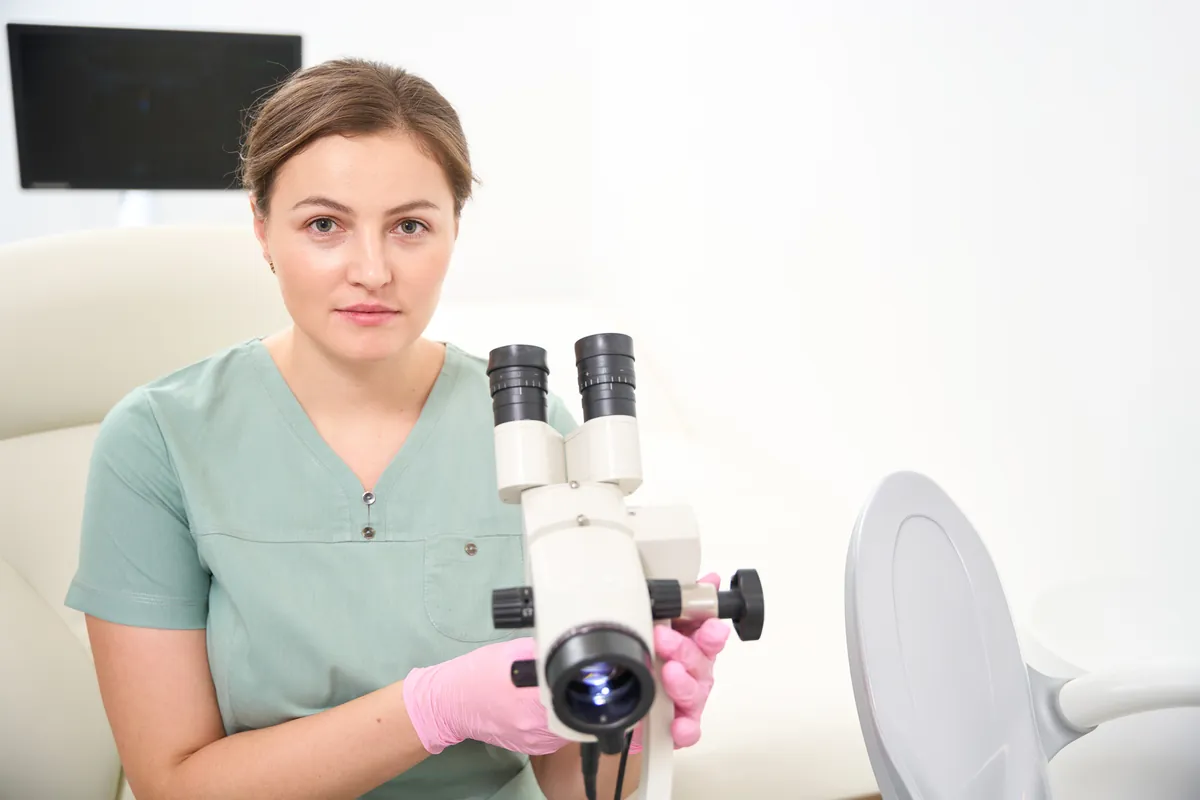
- You lie on the exam table as you would for a Pap test. A speculum holds the vaginal walls apart and the doctor looks at the cervix through a colposcope, a magnifying instrument that stays outside the body.
- A local anesthetic is injected into the cervix. It can sting briefly. A vinegar-like solution may be applied to show the abnormal area more clearly [1].
- The loop removes the tissue in a few minutes. The treatment itself usually takes about 15 minutes or less [1][4]. You may feel pressure, a dull ache or cramping, and some people feel faint for a moment [1].
- A paste may be applied to stop bleeding. It can cause a brownish-black discharge for a few days [1].
About 95 in 100 people need no further treatment after a single LEEP [4][5].
Recovery after LEEP
Most people go back to normal activities and work the next day; a physically demanding job may need a few days off [4]. Period-like cramps for a day or two are common and usually respond to paracetamol (acetaminophen) or ibuprofen [4]. A watery, pinkish or brownish discharge or light bleeding can last for up to a few weeks while the cervix heals [1][5], and your next period may be heavier than usual [5].
While the cervix heals, avoid putting anything in the vagina: no sex, tampons or douching. Many clinics advise about four weeks [4][5]; your own clinic may give a different time, so follow what they tell you. NHS leaflets also suggest avoiding swimming and hot tubs for a few weeks and strenuous exercise for about two weeks [4][5]. Sanitary pads are fine.
When to call your doctor
- Bleeding heavier than a normal period, or bleeding with clots [1]. Heavy bleeding is most likely in the first three weeks [1].
- Severe abdominal pain [1].
- A smelly discharge or bleeding that keeps getting worse, which can be signs of an infection that needs antibiotics [4][5]. A fever is another reason to call.
If bleeding is very heavy and your clinic is closed, go to an emergency department.
Risks of LEEP and repeat LEEPs
Serious complications are uncommon. The main ones to know about are:
- Bleeding and infection in the weeks after treatment (see the warning signs above).
- Cervical stenosis: scarring can narrow the opening of the cervix. Estimates range from 2 to 14 in 100 people, and the risk is higher after menopause, with repeat treatments, or when a larger piece is removed [5]. It can cause painful or blocked periods and make future cervical tests harder to take.
- Effects on a future pregnancy. LEEP does not affect the ability to get pregnant [5], but it slightly raises the chance of an early birth (see the next section).
LEEP and future pregnancy
A Cochrane review pooled data from dozens of studies of women treated for cervical precancer. Overall, the risk of giving birth before 37 weeks rose from about 5.4% in untreated women to about 9.5% in treated women [6]. For LEEP/LLETZ specifically, the risk was roughly 1.6 times higher than in untreated women [6]. Two details matter most:
- Depth: the deeper the piece of cervix removed, the higher the risk. Shallow excisions carried the smallest increase, while excisions of 20 mm or more carried the largest [6].
- Repeat treatment: having a second excision raised the risk of preterm birth much more, to about 15.6% compared with 4.1% in untreated women [6].
These studies were observational, so they can’t fully separate the effect of the treatment from other factors [6]. In practice, it means a surgeon will try to remove only as much tissue as needed, and that it is worth telling your midwife or obstetrician about any past LEEP if you become pregnant so they can monitor you [5].
Your results and follow-up
The lab report usually arrives within a few weeks [5]. It confirms the grade of the abnormal cells and says whether the margins (the edges of the removed tissue) were clear. In a large meta-analysis, about 6.6% of people treated for high-grade precancer had abnormal cells remain or return. The risk was about 3.7% with clear margins and almost five times higher when abnormal cells reached the margin [7]. A positive margin does not automatically mean another procedure; US guidance prefers repeat testing a few months later [3].
The same meta-analysis found that an HPV test after treatment was much better at spotting persistent disease than the margin result alone (91% vs about 56%) [7]. That is why follow-up is built around HPV testing:
- In the UK, a “test of cure” screening test is done about six months after treatment [4].
- In the US, the 2019 ASCCP guidelines recommend HPV-based testing at 6 months, then yearly, and then every three years for at least 25 years after treatment for high-grade precancer [2].
Long-term follow-up is not a sign that something is wrong. It reflects the fact that the risk of cervical problems stays a little higher than average for many years after treatment.
LEEP vs cold knife cone biopsy
A cold knife cone biopsy (conization) removes a cone-shaped piece of the cervix with a scalpel instead of an electrical loop. It is usually done in an operating room under general or regional anesthesia. Doctors may choose it when they need a single, intact specimen with edges that are easy to read, for example when glandular precancer (adenocarcinoma in situ, AIS) is suspected or the abnormal area extends up into the cervical canal. Both procedures remove tissue, so both carry similar considerations for future pregnancies, with depth being the key factor [6].
| LEEP / LLETZ | Cold knife cone | Hysterectomy | |
|---|---|---|---|
| Where | Office or clinic | Operating room | Operating room, hospital stay possible |
| Anesthesia | Local | General or regional | General |
| What is removed | A thin piece of cervix | A cone of cervix | The uterus and cervix |
| Keeps fertility | Yes | Yes | No |
| Usual role | First-line treatment for high-grade dysplasia | When an intact specimen is needed (e.g. AIS) | Specific situations only (see below) |
When is a hysterectomy considered for cervical dysplasia?
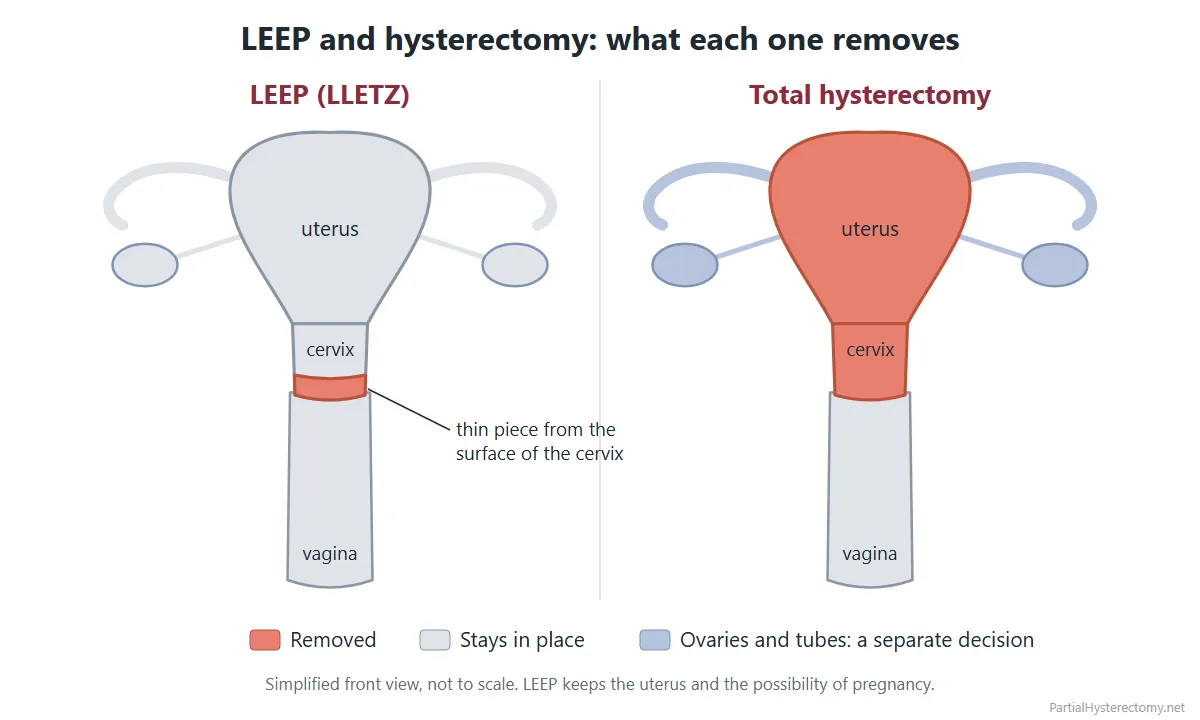
The 2019 ASCCP guidelines state that hysterectomy is unacceptable as the primary treatment when the only problem is high-grade precancer (HSIL, CIN 2 or CIN 3) [2]. A LEEP or cone treats the cervix with a much smaller procedure, and an excision is needed first anyway to rule out hidden cancer. If unexpected cancer were found only after a simple hysterectomy, the operation might turn out to have been the wrong one. Cancer usually calls for a different, carefully planned treatment, sometimes a radical hysterectomy.
Hysterectomy may be discussed in a few situations:
- Adenocarcinoma in situ (AIS) after the diagnosis has been confirmed with an excision. US guidance has preferred hysterectomy for people who have finished having children, because AIS can occur in patches higher in the canal that are harder to remove completely [3].
- High-grade changes that keep coming back after one or more excisions, especially when there is too little cervix left to safely repeat the procedure.
- Another gynecological reason for a hysterectomy, such as large fibroids or heavy bleeding, in someone who also has a history of dysplasia. See our overview of reasons for a hysterectomy.
- Cervical cancer, which is a separate topic covered in our guide to cervical cancer and hysterectomy.
How many LEEPs before a hysterectomy?
There is no fixed number. The decision depends on the grade of the cells, how much cervix is left, your age, whether you want a future pregnancy, and whether you have other reasons for surgery. Because each repeat excision removes more tissue and raises the risk of preterm birth and stenosis [5][6], gynecologists weigh a second or third LEEP more carefully, particularly in people who still hope to have children. If you have had more than one LEEP and the cells keep returning, it is reasonable to ask your gynecologist (or a gynecologic oncologist) to talk through all the options, including hysterectomy.
Why a partial hysterectomy doesn’t solve cervical dysplasia
A partial (supracervical) hysterectomy removes the upper part of the uterus but leaves the cervix in place, and the cervix is exactly where dysplasia develops. When a hysterectomy is done because of cervical disease, it is a total hysterectomy that removes the cervix as well. Our comparison of partial vs total hysterectomy explains the difference in more detail.
Timing between LEEP and hysterectomy
If a hysterectomy is planned after a LEEP, the cervix needs time to heal. A Chinese study of 1,172 women who had a hysterectomy after LEEP found that a longer gap was linked to fewer infections after surgery. The effect showed up mainly with laparoscopic hysterectomy, where an interval of roughly 34 to 90 days was associated with the lowest infection risk; no clear effect was seen for vaginal or open surgery [9]. The study looked back at records, so it shows an association rather than proof, but it is a good question to raise with your surgeon. For what the operation itself involves, see our week-by-week hysterectomy recovery guide.
Do you still need tests after a hysterectomy?
Often, yes. A hysterectomy removes the cervix but not HPV, and the virus can still cause precancer in the top of the vagina (vaginal intraepithelial neoplasia, VAIN). A history of high-grade cervical changes is a known risk factor; reported rates of vaginal precancer after hysterectomy for these changes range from about 0.9% to 7.4% [11]. Vaginal cancer itself is rare [11].
ASCCP advises that people with a history of cervical precancer continue surveillance tests for at least 25 years after their treatment, even if they later have a hysterectomy [10]. Other countries use different schedules; Australia, for example, stops vaginal testing earlier once a test of cure has been completed [11]. Ask your doctor which plan applies to you. Our articles on Pap smears after hysterectomy and vaginal cancer after hysterectomy cover this in more depth.
Questions to ask your doctor
- What grade are my abnormal cells, and is treatment needed now or can we monitor?
- How much tissue do you expect to remove, and what does that mean if I want to get pregnant later?
- Were the margins clear, and when is my follow-up HPV test?
- If the cells come back, what are my options besides another LEEP?
- If a hysterectomy is suggested, why, and will I still need vaginal tests afterward?
Key points
- Cervical dysplasia is a precancer, not cancer, and is caused by persistent HPV infection.
- LEEP is a short office procedure under local anesthetic that clears the abnormal cells in about 95 in 100 people.
- It does not affect fertility but slightly raises the risk of preterm birth, more so with deeper or repeated excisions.
- Hysterectomy is not a first-line treatment for high-grade dysplasia alone; it is reserved for specific situations.
- HPV-based follow-up continues for many years, including after a hysterectomy.
Sources
- American College of Obstetricians and Gynecologists (ACOG). Loop Electrosurgical Excision Procedure (LEEP). Patient FAQ, updated 2022.
- Perkins RB, et al. 2019 ASCCP Risk-Based Management Consensus Guidelines for Abnormal Cervical Cancer Screening Tests and Cancer Precursors. Journal of Lower Genital Tract Disease, 2020.
- American College of Obstetricians and Gynecologists. Management of Abnormal Cervical Cancer Screening Test Results and Cervical Cancer Precursors (2013), summary on Guideline Central.
- North Tees and Hartlepool NHS Foundation Trust. Having a LLETZ (Large Loop Excision of Transformation Zone) Treatment. Patient information.
- East Kent Hospitals University NHS Foundation Trust. Large Loop Excision Transformation Zone (LLETZ). Patient leaflet.
- Kyrgiou M, et al. Obstetric outcomes after conservative treatment for cervical intraepithelial lesions and early invasive disease. Cochrane Database of Systematic Reviews, 2017.
- Arbyn M, et al. Incomplete excision of cervical precancer as a predictor of treatment failure: a systematic review and meta-analysis. The Lancet Oncology, 2017.
- Tainio K, et al. Clinical course of untreated cervical intraepithelial neoplasia grade 2 under active surveillance: systematic review and meta-analysis. BMJ, 2018.
- Ni T, et al. Effect of Time Interval Between LEEP and Subsequent Hysterectomy on Postoperative Infectious Morbidity. Therapeutics and Clinical Risk Management, 2020.
- ASCCP. Tips for Best Practices on Management of Abnormal Vaginal Cytology and HPV Tests. 2024.
- Cancer Council Australia. Screening after total hysterectomy. National Cervical Screening Program clinical guidelines.
This article is for general information and is not a substitute for medical advice. Please talk to your doctor or gynecologist about your own situation, and seek urgent care if you have heavy bleeding, severe pain or signs of infection after any procedure.